






Have you ever noticed how quickly the mind can spiral when life feels uncertain?
One stressful conversation turns into replaying every possible outcome. A difficult situation suddenly becomes a full mental marathon often keeping you from falling asleep at the end of a long day. We start trying to solve things we can’t predict, control, or even fully understand yet.
Our brain often produces 800,000 thoughts on a daily basis. Can you imagine how exhausted we would be if we chose to focus and ruminate on all of them? What if there was a way that we could recenter and ground ourselves during these stressful moments of spiraling thoughts? The great news is there is a method that can help and that is remembering the Circle of Control (Covey, 1989).
What Is the Circle of Control?
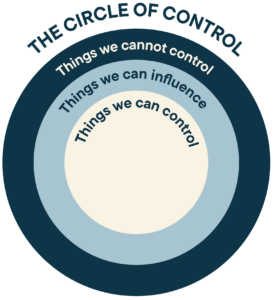
The idea is that there are three ways to categorize life’s circumstances:
1.Things We Cannot Control
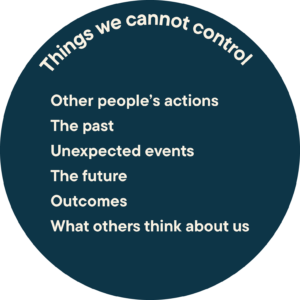
Interestingly enough, this is where many of us spend the most mental energy. We replay conversations. Predict worst-case scenarios. Try to manage everyone else’s reactions. Search for certainty where none exists. The problem is that the more energy we spend outside our control, the more overwhelmed and powerless we tend to feel.
2.Things We Can Influence
This middle space is important too. We may not be able to control the final outcome, but we can influence certain things through:
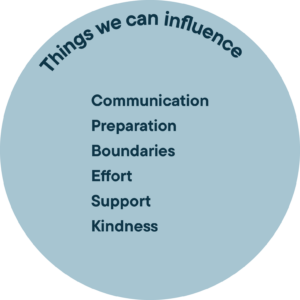
Influence is different from control. It means we can contribute without carrying the impossible responsibility of controlling everything. Often times many of us can take on heaviness from others and circumstances that are being out control, and this can have a very negative affect on our own mental well-being.

3.Things We Can Control
This is the center of the circle the part that can bring us the most calmness and sense of grounding if we learn how to properly focus our energy there.
We can control:
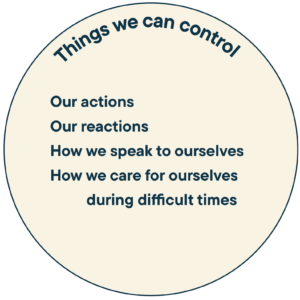
Focusing here doesn’t magically erase stress, but it often creates something we desperately need during hard moments and that is stability. When we’re anxious or emotionally overwhelmed, the brain naturally searches for certainty and safety. Unfortunately, it often looks for them in places we can’t actually control.
That’s when spiraling thoughts begin:
- “What if this happens?”
- “What if they think this?”
- “What if everything goes wrong?”
The Circle of Control gently redirects us back to the present moment. It reminds us to separate the fear thoughts from the real thoughts. Fear thoughts are often those thoughts we have that end in a question mark “what if they don’t like me?” “what if I do not get the job?” “what if I shared too much?” These thoughts are not backed by facts or data, rather they are fueled by fear. Instead we need to gently redirect our brain to focus on the facts, or the thoughts that are backed by data and proof. This could look like, “she texted after our date and said she had an amazing time” or “my interview went well, and they told me they would reach out about the second interview next week.” By focusing on the thoughts that are rooted in facts we can prevent ourselves from spiraling and spending our precious energy on the things we do not have control of.
A Small Practice to Try
The next time you feel overwhelmed, pause and ask yourself:
What am I trying to control right now?
Then sort it into categories:
- Can’t control
- Can influence
- Can control
Once you identify what’s actually within your control, focus your energy there.
Maybe it’s:
- Taking a walk
- Sending one honest message
- Setting a boundary
- Drinking water and getting some sleep
- Reaching out for support
Life will always contain uncertainty. There will always be things we wish we could predict, fix, or manage. But peace doesn’t usually come from controlling everything around us, more often, it comes from strengthening the way we respond to what’s happening. The Circle of Control reminds us that while we may not control every circumstance, we do have power in how we move through them — and sometimes, that’s where resilience and mental well-being begins.

References:
Covey, S. R. (1989). The 7 habits of highly effective people: Restoring the character ethic. Simon & Schuster.